How to Lift Without Hurting Your Back
Most back strain doesn't happen in the gym. It happens in the driveway, hauling grocery bags out of the trunk. It happens in the living room, scooping up a toddler who refuses to walk another step. It happens in the garage, moving boxes that seemed lighter when you picked them up.
These small, everyday lifts add up because we rarely think about how we're doing them. We're distracted, in a hurry, or reaching at an awkward angle. Over time, those little moments of poor mechanics can lead to soreness, stiffness, or a nagging ache that shows up the next morning.
The good news is that safe lifting isn't complicated. It just takes a little awareness and a few habits you can build into your day without much extra thought.
Why Everyday Lifting Adds Up
Your back is built to handle a lot, but it works best when the load is close to your body and your other muscles are helping share the work. When you bend from the waist, twist while carrying something, or reach out with your arms extended, your lower back ends up doing most of the job alone.
That's when strain creeps in. It's rarely one big, dramatic lift that causes trouble. More often it's the repeated pattern of small, awkward lifts done the same way, day after day, that leaves your back feeling tight or achy.
The Basics of Safe Lifting Mechanics
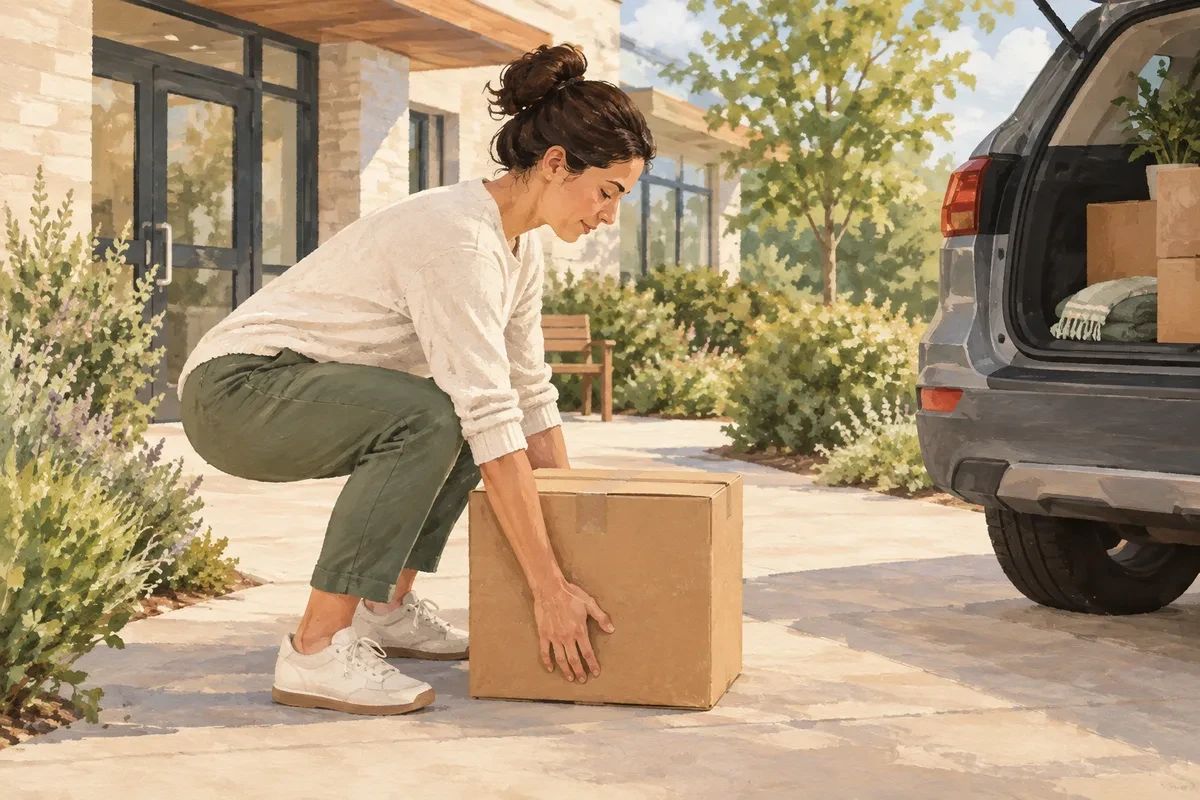
Start with your feet. Give yourself a stable base by placing your feet shoulder width apart, with the object centered between them if possible. This gives you better balance and control before you even begin to lift.
Bend at your hips and knees, not just your waist. Think about lowering your whole body toward the object rather than folding forward at the middle. Keeping a slight natural curve in your lower back, rather than rounding it, helps distribute the effort more evenly.
Hold the object close to your body as you lift, and let your legs do the heavy work by pushing through your heels as you stand up. Avoid twisting while you lift. If you need to turn, move your feet to change direction instead of rotating through your spine.
Breathing matters too. Many people hold their breath during a lift, which can create unnecessary tension. Try exhaling as you stand up with the load.
Common Everyday Lifting Situations
Grocery bags are deceptively tricky because they're often lifted from a car trunk, which puts you in a bent-over, reaching position. Try scooting the bags toward the edge of the trunk first, then use the same hip-and-knee bend you'd use for any other lift, keeping the bag close to your torso as you bring it toward you.
Picking up kids is its own challenge, since they move and shift their weight unexpectedly. When you can, crouch down to their level first instead of leaning over, then lift by straightening your legs rather than pulling up with your back.
Boxes and furniture around the house deserve the same care as anything at a gym. Check the size and shape before you commit to a lift, get as close to the item as possible, and ask for help with anything oversized or oddly shaped. There's no downside to grabbing a second set of hands.
Building Better Habits Over Time
Good lifting mechanics work best when they become automatic, not something you have to remember in the moment. Practicing the basic hip-and-knee bend during low-stakes moments, like picking up a laundry basket, helps your body default to that pattern when it matters more.
It also helps to build general strength and mobility in your hips, core, and legs, since these areas support your back during any lift. Staying active and moving through a full range of motion in daily life keeps those muscles ready to help share the load.
If you've been dealing with back discomfort that doesn't seem to improve, or if certain movements consistently feel off, it's worth having it looked at. At Summit Physical Therapy in Austin, our team works with patients through sports rehab, post-surgical rehab, dry needling, and vestibular therapy, and we're glad to talk through your specific situation and how your body moves through daily tasks.
Everyday lifting doesn't have to be a source of worry. With a little attention to form and some patience while building better habits, most people can carry groceries, lift kids, and move boxes with far less strain on their back. If you have questions about your own movement patterns or ongoing discomfort, give us a call and we'll help you figure out the next step.
Questions about your own care? The team at Summit Physical Therapy is happy to help — call us at (512) 555-0188 or request an appointment.
This article is for general information only and is not medical advice.